

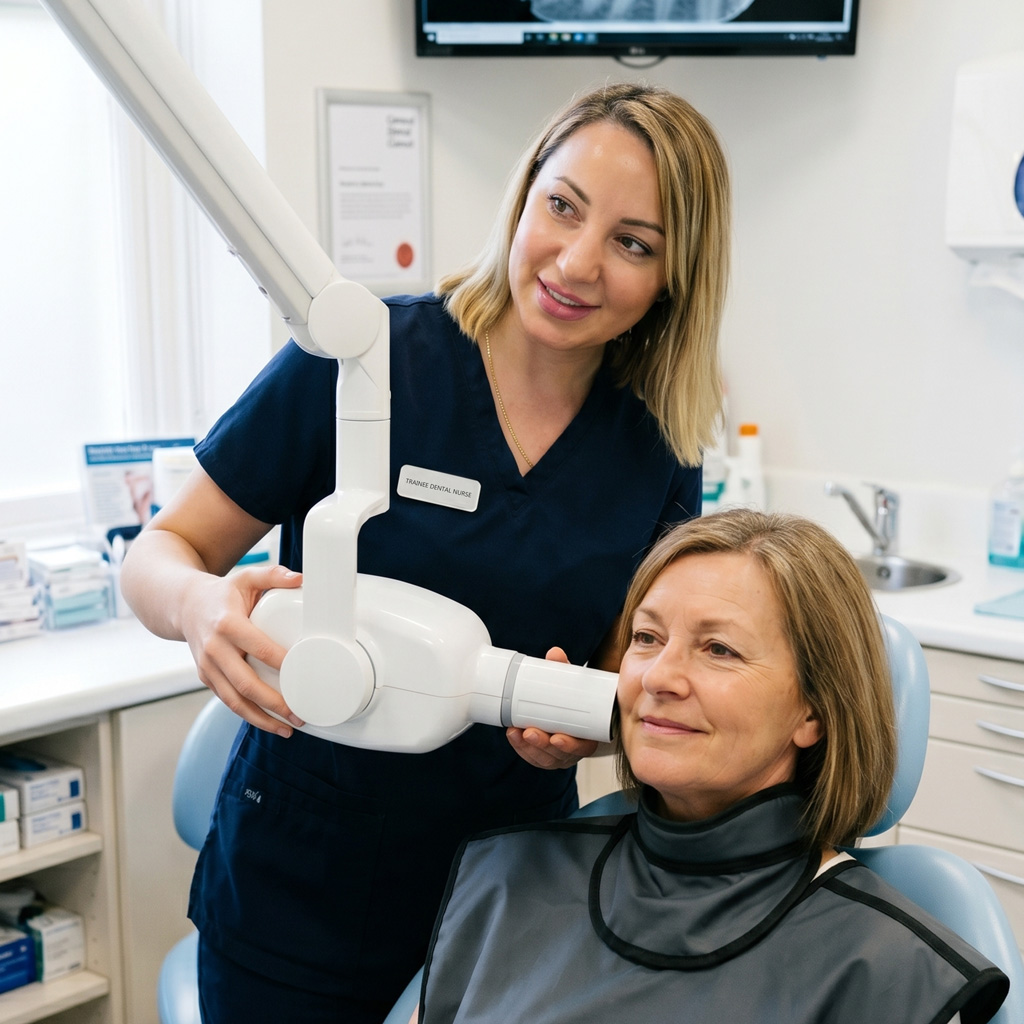
Many patients have concerns about radiation exposure when dental X-rays are recommended. This is completely understandable, and we believe it is important that patients are fully informed about why X-rays are taken and how little radiation is involved.
Without X-rays, important dental problems may go undetected until they become more serious, more painful, and more expensive to treat.
Modern digital dental X-rays use extremely low doses of radiation.
A periapical X-ray shows the entire tooth, including the root and surrounding bone.
Typical radiation dose: approximately 1–5 microsieverts (µSv)
A bitewing X-ray is used to detect decay between teeth and assess bone levels around the teeth.
To put this into perspective, the average person in the UK receives around 2,700 microsieverts (2.7 mSv) of natural background radiation every year simply from living on Earth.
We are exposed to small amounts of natural radiation every day from the sun, soil, rocks, air, and even food.
|
Activity
|
Radiation Exposure
|
|---|---|
|
One dental periapical X-ray
|
1–5 µSv
|
|
One dental bitewing X-ray
|
1–5 µSv
|
|
Daily natural background radiation in the UK
|
7–8 µSv
|
|
Flight from London to Barcelona
|
10–20 µSv
|
|
Flight from London to New York
|
30–80 µSv
|
|
Eating a banana
|
0.1 µSv
|
|
Chest X-ray in hospital
|
Approximately 100 µSv
|
|
CT scan of the head
|
Approximately 2,000 µSv
|
|
CT scan of the abdomen
|
Approximately 8,000–10,000 µSv
|
This means that a dental X-ray often exposes you to less radiation than you naturally receive from the environment over the course of a single day.
By comparison, a dental periapical or bitewing X-ray is only a tiny fraction of these doses.
Modern digital systems have reduced radiation doses dramatically compared with older film-based technology.